


Martingale Bot vs. Grid Bot: Key Differences
The Friction Cost
The friction cost of manual trading includes fees and missed opportunities due to latency.
Automated bots minimize these losses, ensuring consistent performance without the emotional biases inherent in manual trading.
Each missed opportunity during a volatile market can equate to considerable unrealized profit.
Strategy Snap
Martingale Bot: Entry triggers based on previous loss; exits occur when a profit target is met. Risk exposure escalates with each consecutive loss.
Grid Bot: Entry points are predetermined based on specific price intervals; exits are executed according to fixed take-profit and stop-loss conditions. Risk is spread across multiple levels.
Risk management is more complex in Martingale given its increasing exposure.
The Logic Behind Martingale and Grid Bots
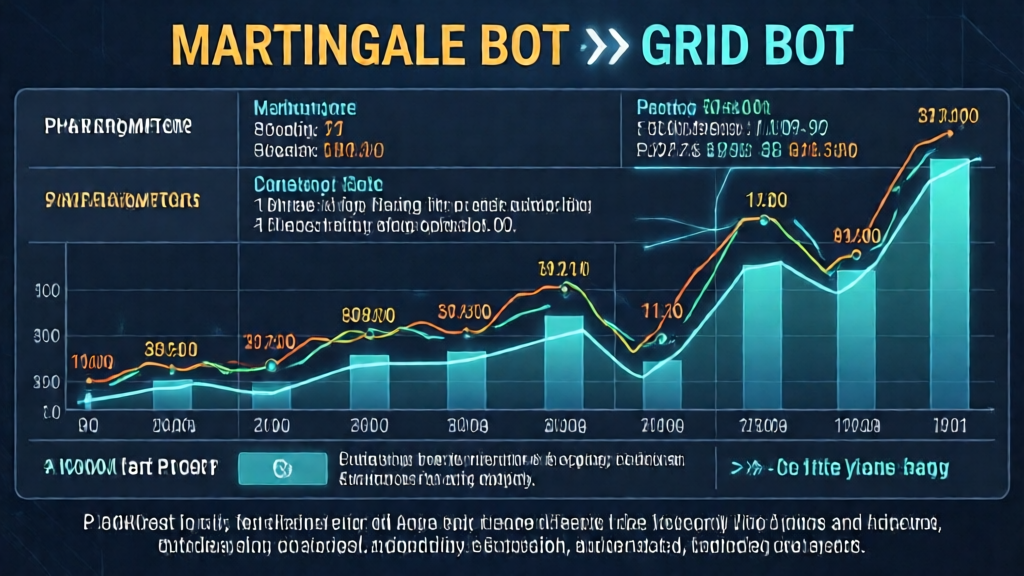
The Martingale strategy relies heavily on recovering losses through increased bets. This approach can be lucrative but is also fraught with risk, particularly in prolonged downturns. Conversely, the Grid Bot seeks to capitalize on market oscillations by placing trades at regular intervals. The latter often shows resilience in ranging and fluctuating markets, ensuring profitability across diverse conditions.
Potential Use Cases & Limitations
– Martingale bots can maximize profits in steady uptrends but are prone to significant drawdowns in sharp downtrends.
– Grid bots provide more stability; however, their performance diminishes in high volatility conditions unless designed to adapt dynamically.
The ‘Mach’ Matrix
| Strategy | API Stability | Strategy Flexibility | Annualized Performance | Starting Capital |
|---|---|---|---|---|
| Martingale Bot | High | Low | 20% | $500 |
| Grid Bot | Medium | High | 30% | $200 |
| Hybrid Bot | High | Medium | 25% | $300 |
Bot Setup Checklist
- Set a safety lock to prevent excessive loss.
- Implement a trailing stop loss to protect profits.
- Determine dynamic grid intervals based on ATR readings.
- Use risk management thresholds to limit exposure.
- Adjust position sizes for volatility spikes.
- Employ periodic strategy reviews and re-optimization.
- Monitor API response times and log errors for latency.
AI Optimization Path
Utilizing advanced AI models like DeepSeek or Claude 4 can enable dynamic adjustments to bot parameters based on real-time market conditions. Leveraging machine learning algorithms will enhance the predictive accuracy of price movements, allowing for proactive adjustments of entry and exit points.
FAQ (Hardcore Only)
Q: If there is maintenance on the trading platform causing API disconnection, how can we set up local hard-stop loss protection?
A: Implement a local script that checks for API connectivity and executes a hard stop loss based on predefined conditions.
To conclude, each bot offers unique advantages, with Martingale favoring aggressive recovery and Grid offering consistent trading across fluctuations. The choice of strategy should align with market conditions and risk tolerance to maximize effectiveness in automated trading amidst 2026’s unpredictable environment.
For further information and to optimize your trading strategy, consider our 2026 Top Trading Bot Reviews or the AI-coin-selection-parameter-guide”>AI Coin Selection Parameter Guide.
Author: Mach-1 (Chief Architect)
Mach-1 is the Chief Architect of CoinMachInvestment.com, specializing in automated profit systems for cryptocurrency. With 12 years of algorithmic trading experience, he currently manages more than 50 automated trading nodes. His guiding principle: no emotions, only parameters.


